

The Quiet Advantage
Everyone's racing to implement AI. But the organizations actually getting value aren't the ones moving fastest. They're the ones moving with intention.
I've spent the last year working with nonprofits, civic organizations, and mission-driven founders on AI adoption. The pattern is clear. The competitive edge isn't access to the same tools everyone else has. It's people who know how to use them.
The Real Gap Isn't Technology
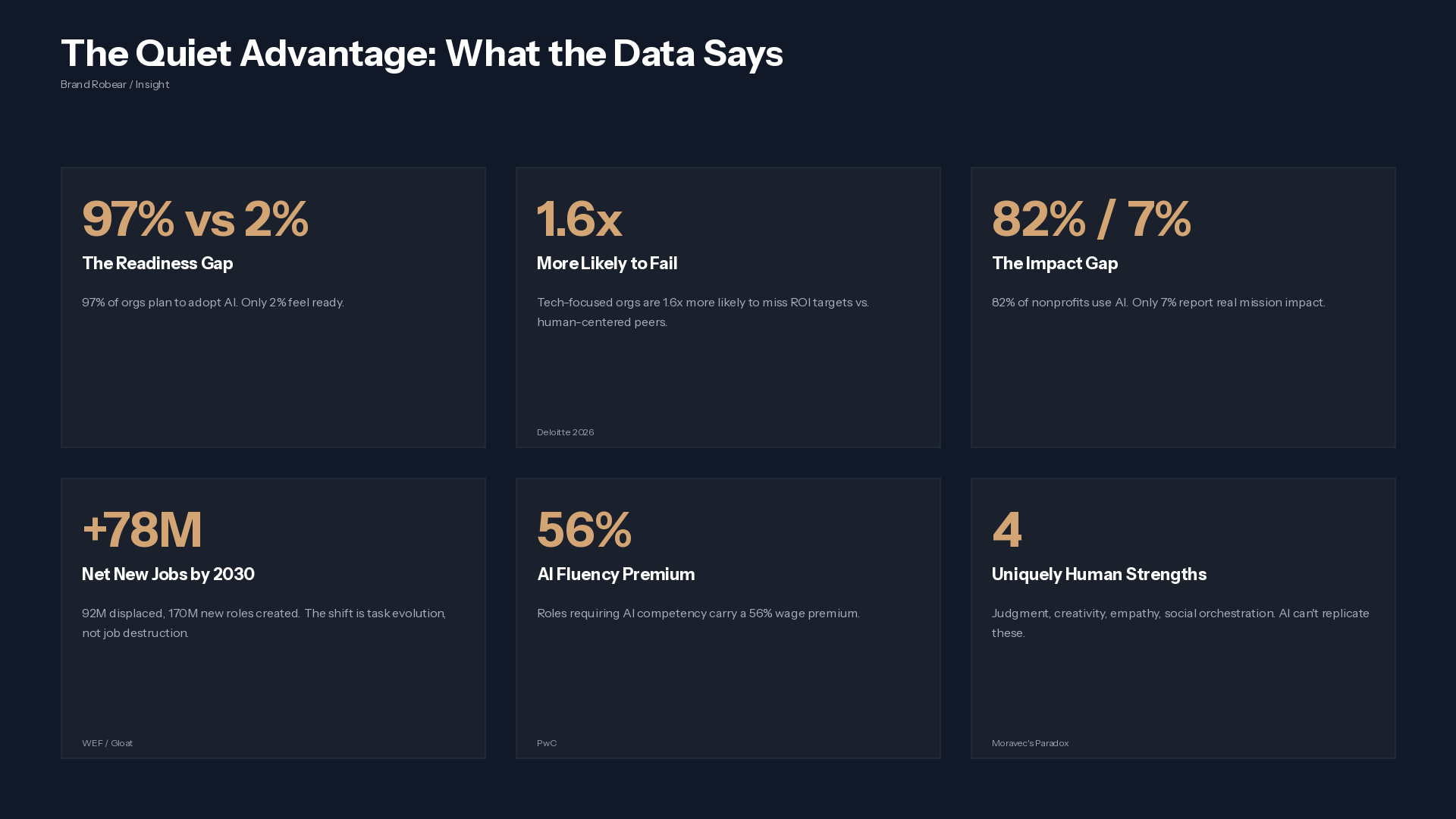
Here's what I'm seeing: 97% of organizations say they plan to adopt AI. Only 2% feel ready. That gap isn't about the tools. It's about readiness, intention, and understanding what AI actually does and doesn't do well.
Deloitte's research backs this up. They found that 59% of organizations are taking a tech-focused approach to AI, treating it as an efficiency problem to solve. Those organizations? They're 1.6 times more likely to miss their return on investment targets compared to peers who pair AI with intentional human-centered strategy.
That's not a small difference. That's the difference between a tool that pays for itself and a tool that costs money you didn't budget for.
The Paradox Everyone's Missing
The same tools that can instantly process 10,000 documents struggle with what seems simple to humans: knowing when a conversation needs empathy, understanding cultural context, making judgment calls in ambiguous situations.
This is Moravec's Paradox in action. AI excels at complex logical reasoning but stumbles on the things humans do without thinking. Judgment. Trust. Knowing when a policy needs flexibility. Reading a room.
In healthcare, it's playing out in real time. Patients consistently bypass AI chatbots to reach human doctors. Not because the AI gives worse information. Because trust is emotional, not logical.
For the organizations we work with, this matters concretely. A nonprofit's community engagement work can't be fully automated because the work is relational. A civic organization's policy work requires judgment calls that reflect community values, not just data. A cultural institution's storytelling requires context that no tool can fully capture.
What the Data Actually Says
The World Economic Forum projects that AI and automation will displace 92 million jobs by 2030. That's real, and it's worth taking seriously. But there's something else in that same forecast: 170 million new roles emerge in the same timeframe. Net gain of 78 million positions.
The jobs that grow? Ones that pair technical fluency with distinctly human skills. Roles requiring AI competency carry a 56% wage premium. But the jobs that disappear are the ones AI can do alone.
For nonprofits, the picture is even starker. 82% of nonprofits now use AI in some form. Less than 10% have formal policies around it. Only 7% report real mission impact from their AI work. That's not a technology problem. That's a strategy problem.
What Intentional Adoption Actually Looks Like
This is where I've seen organizations break through. They start by asking the right question: not "Can we use AI for this?" but "Should we, and if so, where do humans stay in the loop?"
A few concrete things they do differently.
They build policy alongside tools. Before deploying anything, they define who decides what, where human judgment stays, how they measure success beyond efficiency metrics. It takes longer than just turning something on. It pays off in implementation.
They invest in readiness. Not training everyone to be an AI expert. Training the right people to understand what their specific tools do and don't do well. Understanding the risks. Knowing when to rely on it and when to override it.
They stay mission-centered. One nonprofit I worked with started evaluating AI tools by asking: does this strengthen or weaken our relationship with the people we serve? Rejected tools that saved time but created distance. Kept the ones that made staff more present and thoughtful.
They build for long-term value, not quick efficiency gains. Quick wins feel good. But sustainable competitive advantage comes from organizations that can integrate AI in ways that align with who they are and what they're trying to build. That takes intention.
Why This Matters for Your Organization
If you work in the nonprofit sector, civic space, or cultural institutions, you're probably feeling pressure to move fast on AI. Boards are asking about it. Staff wants guidance. Competitors seem ahead.
The quiet advantage is resisting the pressure to chase efficiency for its own sake. Instead, take the time to ask what AI actually serves in your work. Where does it create bandwidth for people to do what only humans can do? Where does it risk replacing relationships with automation?
In Michigan, we're seeing this play out already. The Small Business Technology Fund is putting $1,000 grants into microbusinesses to build AI capacity. AutoSitu is using AI to interpret zoning code for community organizations. These are examples of intentional deployment, not just technology adoption.
The organizations winning this moment are the ones treating AI as a means to strengthen their human work, not a replacement for it.
What's Next
If you're trying to figure out your organization's AI strategy, start here: What are the three things AI could do in your work? For each one, ask: Would this create more time for humans to do what matters? Or would it create distance?
That question changes everything.
Then, if you want to go deeper, let's talk about what intentional adoption looks like for your specific work. Not a one-size-fits-all implementation. A strategy that fits who you are and what you're building.
Reach out if you want to explore this. We work with organizations that are serious about long-term value, not quick wins.